
Putin’s Monuments and the Russian Myth
How Statues, Memorials, and Symbols Shape National Memory and Authority


Across Russia and even in neighboring post-Soviet states, monuments to Vladimir Putin are appearing in unexpected places, from snow-dusted ski resorts in Kyrgyzstan to Moscow’s central squares. Bronze busts, Roman-style effigies, and larger-than-life sculptures cast the current president alongside tsars, Soviet heroes, and Orthodox saints, blending past and present into a single narrative of strength and authority. These statues are far more than admiration, they are a deliberate projection of power, a tangible symbol of the Kremlin’s effort to shape public memory, reinforce national identity, and connect Putin’s leadership to centuries of Russian history.
These statues are not an isolated whim. Across Russia, the landscape is transforming into a museum of power. From monumental depictions of tsars like Alexander III and Nicholas II to towering figures of Prince Vladimir and even Stalin, the state is selectively resurrecting symbols of the past to create a continuous narrative of strength, unity, and national destiny. Each statue, whether of a medieval saint, a 19th-century autocrat, a Soviet hero, or the current president himself, functions as a tangible lesson: Russian history, like its leaders, is to be celebrated, controlled, and made to serve the present.
In this reshaped Russia, monuments are not mere memorials, they are instruments of ideology. They tell citizens which figures to revere, which events to remember, and which stories of shame or dissent to forget. As Putin’s likeness joins the pantheon of Russian symbolism, it becomes clear that the Kremlin’s project is more than nostalgia; it is a deliberate, ongoing effort to sculpt history itself into service of the state.
In the tumultuous aftermath of the Soviet Union’s collapse, Russia was plunged into an identity crisis. The communist ideology that had structured reality for seven decades vanished, leaving a void filled with economic shock, geopolitical humiliation, and a disorienting question: what did it mean to be Russian without the USSR? To address this, the Kremlin, under Vladimir Putin, embarked on a long-term project to forge a new national consciousness. This project is anchored in the concept of the “Russian World” (Russkiy Mir) and relies on the strategic construction of a “Useful Past” (Foreign Policy, 2022).
The Russkiy Mir ideology posits that Russia is not merely a nation-state but a unique and distinct civilization. This transnational community is bound by shared language, culture, and, crucially, the spiritual bedrock of the Russian Orthodox Church. It extends beyond Russia’s political borders to encompass what Moscow considers its historical lands, particularly Ukraine and Belarus. This concept provides the ideological justification for a foreign policy framed not as interference, but as protection. As Putin stated in his pivotal 2021 essay “On the Historical Unity of Russians and Ukrainians,” he asserted that Russians and Ukrainians are “one people – a single whole” (Kremlin.ru, 2021) effectively denying Ukraine’s sovereignty and laying the historical groundwork for the 2022 invasion.
The Kremlin’s narrative does not simply celebrate history; it synthesizes it, creating a continuous thread of “Great Russian Statehood.” This formula selectively selects symbols and figures from different, often contradictory, eras to build a story of strength, sovereignty, and spiritual endurance.
The Tsarist Empire: The Autocracy of Order and Faith.
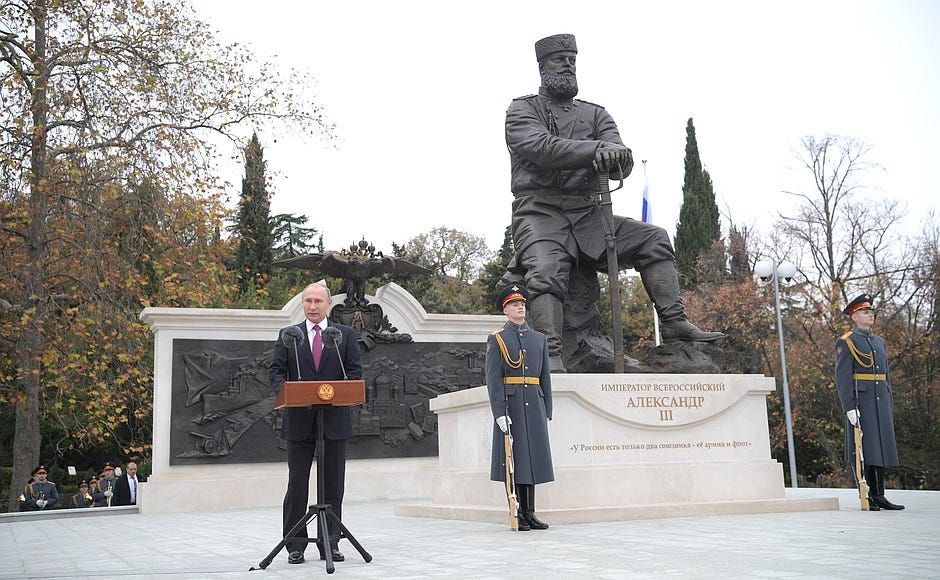
This strand venerates strong, centralized autocracy and imperial expansion. Figures like Ivan the Terrible and Nicholas I, once viewed with ambivalence, are now rehabilitated as firm rulers who held the state together. The most telling example is Alexander III, known for rolling back reforms and championing “Russification.” A monumental statue of him was unveiled in annexed Crimea in 2017, with Putin praising him as a “patriot and statesman” who “always strove to do everything for the country’s development and strengthening” (Kremlin.ru, 2017). This directly models the ideal of a leader who prioritizes state power above all.
The Soviet Union: The Glory of Victory and Power.
The Kremlin performs a delicate balancing act with the Soviet era. The repressive, totalitarian aspects are minimized, while the aspects that project power and glory are amplified to their maximum. The cornerstone of this is the Great Patriotic War. The victory over Nazism has been elevated into a civic religion, a sacrosanct event that justifies past sacrifices and present-day policies. This narrative was weaponized explicitly in the lead-up to the invasion of Ukraine, with Putin falsely claiming the goal was the “denazification” of the country, rhetorically casting his modern military campaign as a continuation of the Soviet Union’s heroic struggle (NPR, 2022).Putin: The Heir to Both Thrones.
Contemporary Russia under Putin is portrayed as the rightful heir to both legacies. This was perfectly encapsulated in the 2021 “Unity Day” monument in Moscow, which features statues of figures from every major era, from Tsarist generals and imperial ministers to Soviet WWII heroes, standing together. There is no distinction between victor and vanquished; all are unified in service to the state. Most strikingly, Putin himself drew this line explicitly in a 2022 speech justifying the war in Ukraine, comparing it to Peter the Great’s 18th-century campaigns. “It seems it has fallen to us, too, to take back and strengthen,” he stated, directly framing a modern war of aggression as the reclamation of historical lands, casting himself in the mold of an imperial tsar (The Guardian, 2022).
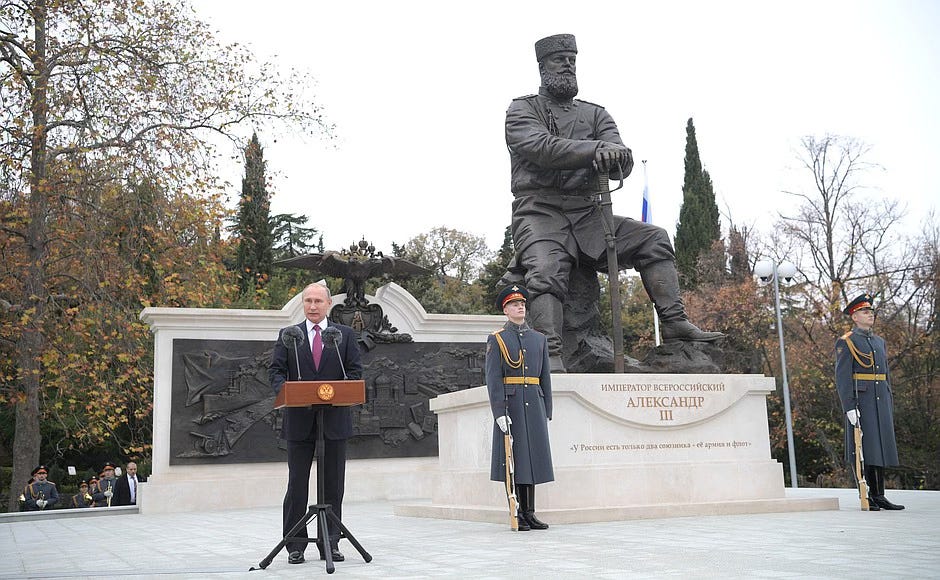
The ultimate purpose of this historical synthesis was to create a single, unifying story capable of uniting a nation disoriented by the collapse of the Soviet Union. This new narrative served a powerful dual function, addressing both domestic unity and foreign policy ambitions. Domestically, it forges a cohesive national identity that transcends the traumas of the 20th century, offering a proud, continuous story to replace post-Soviet shame. It provides a “single, unbroken thread of history,” as Putin has termed it, that legitimizes his regime as the culmination of Russia’s historical destiny. Externally, this narrative directly underpins and justifies Russia’s revanchist ambitions. The annexation of Crimea in 2014 was sold to the Russian public not as a violation of international law, but as the “return of Crimea to its home harbor,” a correction of a “historical injustice” from the Soviet era. The war in Ukraine is framed not as an invasion of a sovereign neighbor, but as a defense of the Russkiy Mir and a necessary campaign to “gather the historic Russian lands.”
In the years following the collapse of the Soviet Union, its symbols were systematically removed from public spaces in what appeared to be a definitive break with the past. Yet under Vladimir Putin’s leadership, Russia has witnessed a remarkable symbolic resurrection. This process began subtly but gained momentum throughout the 2000s, transforming Russia’s visual landscape and historical narrative.
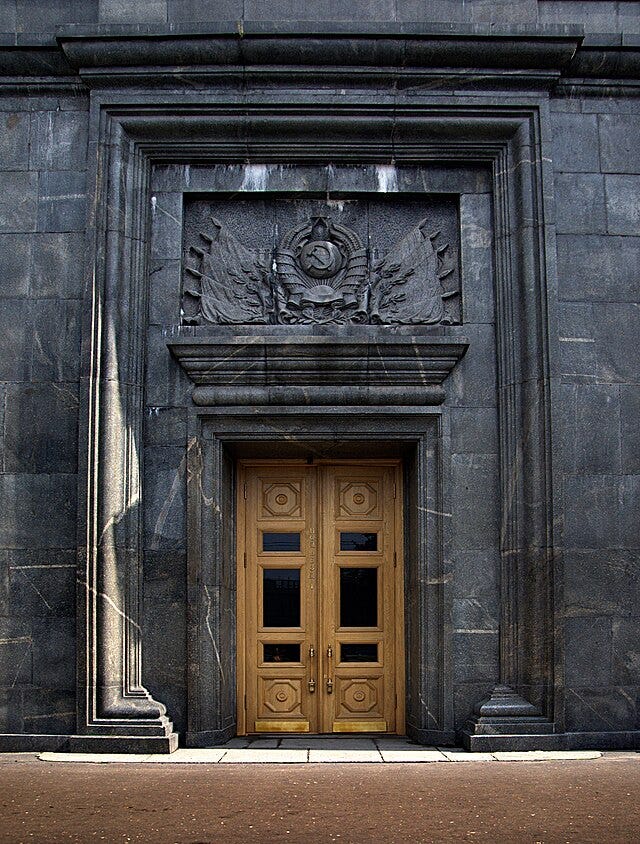
The return of Soviet symbolism has been both calculated and conspicuous. The most telling example appeared on the façade of the Lubyanka building, headquarters of the FSB, the KGB’s successor, where the Soviet-era security service emblem quietly reappeared.
In June 1999, Vladimir Putin commemorated Yury Andropov’s 85th birthday by laying flowers on the late Soviet leader’s grave. Shortly after becoming president in 2000, he ensured that a plaque honoring Andropov was placed on the Moscow building where he had once lived. By June 2004, on what would have been Andropov’s 90th birthday, Putin oversaw the installation of a ten-foot statue of him in Petrozavodsk, near St. Petersburg. These gestures underscored the enduring significance of Andropov’s legacy in shaping Russia’s contemporary leadership.
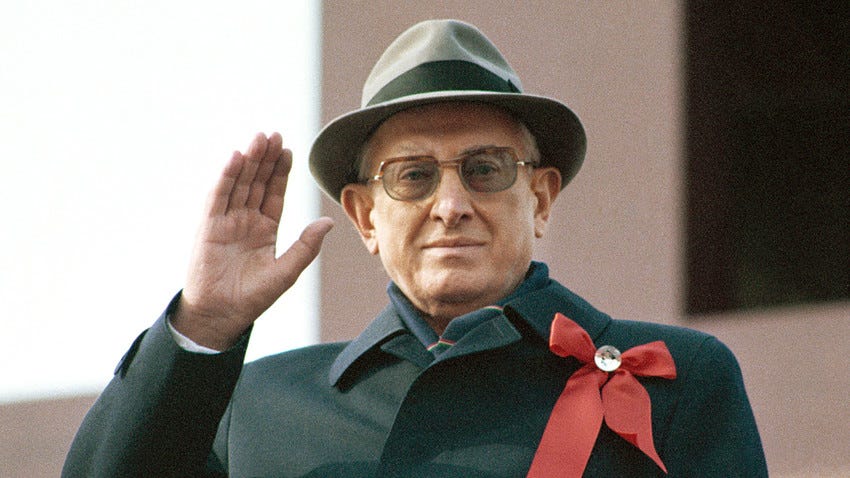
For Putin and his inner circle, Andropov represents a model of statecraft that blends strict political control with selective economic reform. His approach—what scholars describe as “authoritarian modernization”—sought to strengthen the state while carefully managing economic changes, without embracing Western-style democracy or pluralism. As Olga Kryshtanovskaya, head of the Russian Academy of Sciences’ Institute for Elite Studies, explained in 2007:
“Andropov thought that the Communist Party had to retain power while implementing economic liberalization—similar to China’s path. For those in the security services, China represents the ideal. They regard Yeltsin’s and Gorbachev’s approaches as mistakes” (Radio Free Europe, 2009).
Kryshtanovskaya added that Putin and his protégés considered Andropov “a genius, a very strong person who, if he had lived, would have carried out the right reforms.” His vision of tightly controlled modernization continues to resonate within the current Russian elite, shaping their approach to governance, state security, and the delicate balance between reform and authority.
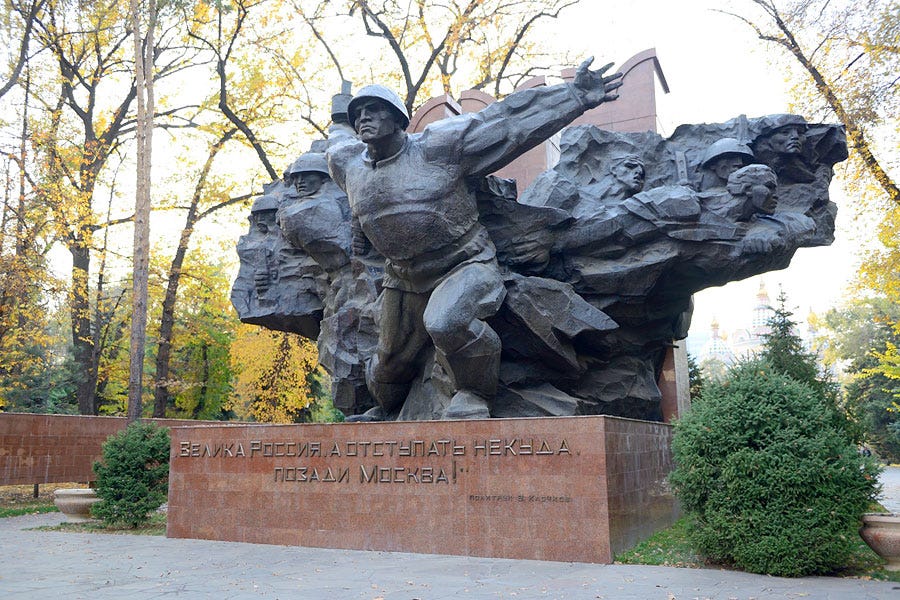
Just as Russia has revived Soviet-era symbols to project power and continuity, other post-Soviet states have also turned to World War II memory to shape national identity. In Almaty, Panfilov Park commemorates the Panfilov Division, a group of soldiers who famously defended Moscow and made the ultimate sacrifice. The park’s memorial, inspired by the legendary stand of 28 infantrymen, illustrates how historical memory can be used to honor heroism and patriotism, rather than to assert contemporary political authority. Within the park stands a memorial honoring fallen Soviet soldiers, inspired by the famous, albeit controversial, story of their courageous stand. According to official Soviet accounts, on November 16, 1941, the Red Army’s 316th Rifle Division, known as the “Panfilov” division after their commander, heroically defended their position on the road to Moscow. The 28 infantrymen valiantly resisted, destroying 18 German tanks, and buying precious time for Moscow’s defenders to organize. In a moment of defiance, company political officer V.G. Klochkov rallied his comrades, declaring, “Russia is a vast land, but we have nowhere to retreat—Moscow is behind us!” before sacrificing himself under an oncoming tank with grenades in hand. All 28 soldiers perished, with the last recounting the battle’s details before succumbing to his wounds in a military hospital. The story captured the imagination of the Soviet Union, becoming a symbol of patriotism and inspiring songs and poems across the nation. However, following the revelation that two supposed martyrs were still alive, the military prosecutor’s office was compelled to launch a special investigation (Atlas Obscura, 2018).
An official investigation in 1948, led by military judge Lieutenant-General Nikolai Afanasyev, disputed the myth of the last stand, calling it a fabrication which served to bolster Soviet heroism in Stalin’s propaganda machine. The investigation’s findings, however, were kept under wraps to preserve the myth, ensuring a united front in the aftermath of war. Decades later, as the truth resurfaced amidst a cinematic portrayal, Sergei Mironenko, Russia’s chief state archivist, bravely released documents online, advocating recognition for all soldiers of Panfilov’s division, not just the mythical few. Sergei Medinsky, the Culture Minister of Russia, stood in support of the film, asserting that, “even if this story was invented from start to finish, if there had been no Panfilov, if there had been nothing, this is a sacred legend that shouldn’t be interfered with. People that do that are filthy scum” (The World from PRX, 2016).


As a part of his revival of the memory of World War II Putin has actively portrayed Stalin as a strong leader who saved the world from fascism. In 2015, the 70th anniversary of the World War II was the first time Russia saw a lavish praise for Stalin, with Putin praising Stalin for signing the nonaggression pact with Nazi Germany. Stalin came into discussion again in 2017 when Oliver Stone interviewed Putin. Putin said Stalin was a product of his time and demonizing Stalin an attack on the Soviet Union and Russia. By 2019, Putin had served as president longer than Stalin and a March 2019 poll found that 70% of Russians saw Stalin’s role as positive and was an outstanding figure in history, with only 19% saying they had a negative perception of Stalin (Washington Post, 2019).
At the same time, there have been a steady increase in monuments dedicated to Stalin. 110 monuments have appeared in 40 regions with about 10 of them being original statues from Soviet times. A total of 95 of the Stalin statues have appeared during Putin’s presidency, with about 50 of them appearing from 2014-2023. While official endorsements of the statues are limited, Vladimir Medinsky appeared at the opening of a Stalin monument in Tver (Re: Russia, 2023).
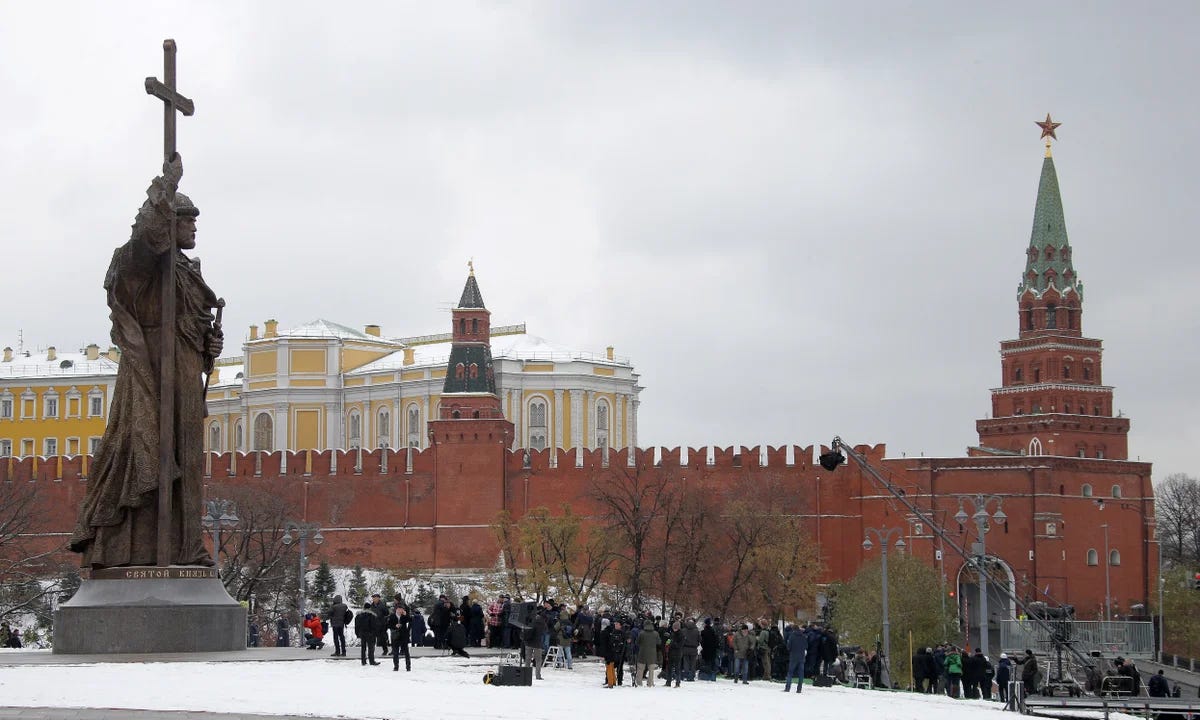
One striking example of Russia’s turn toward historical grandeur is the colossal statue of Prince Vladimir, erected near the Kremlin in Moscow. The monument, towering over the city, celebrates Vladimir the Great, the 10th-century ruler who Christianized Kievan Rus’. Beyond commemorating a historical figure, the statue functions as a symbolic anchor for Russian national identity, linking the contemporary state with a narrative of religious and political continuity. By glorifying Vladimir, the Kremlin emphasizes themes of strength, unity, and moral authority, qualities that resonate with the broader project of restoring a sense of historical destiny for Russia.
The monumental statue of Prince Vladimir near the Kremlin was erected through the joint initiative of the Russian Military-Historical Society and the Moscow City Government and was sculpted by Salavat Shcherbakov, People’s Artist of the Russian Federation. Its unveiling drew high-level attendees, including Prime Minister Dmitry Medvedev, Culture Minister Vladimir Medinsky, Moscow Mayor Sergei Sobyanin, members of government, NGOs, and representatives from science, culture, and the arts. Patriarch Kirill of Moscow and All Russia consecrated the monument, and commemorative flowers were laid at nearby memorials by leaders of Russia’s major religious communities, youth activists, and cultural organizations. Putin also visited the Orthodox Russia exhibition and forum, part of the ongoing Russia – My History series highlighting the nation’s past.


In his address, President Putin framed Prince Vladimir as both a saint and a unifying national figure, praising him as a visionary ruler whose Baptism of Rus established moral and spiritual foundations that continue to shape Russia, Belarus, and Ukraine. Putin emphasized Vladimir’s role as a unifier of lands, peoples, and religions, presenting him as a model for confronting modern challenges while preserving the continuity of Russia’s thousand-year history. Patriarch Kirill highlighted Vladimir’s sincere choice of faith and devotion to truth, portraying him as a figure whose moral decisiveness shaped the destiny of his people and the Russian state.
Natalya Solzhenitsyn of the Solzhenitsyn Foundation framed the monument as both a landmark and a moral challenge, urging reflection on national history and responsibility.
“We should respect our history, take pride in our nation’s achievements, its heroes and its righteous. But we should also have honesty and courage to condemn evil, not justify it or sweep its memory under the carpet” (Kremlin.ru, 2016).
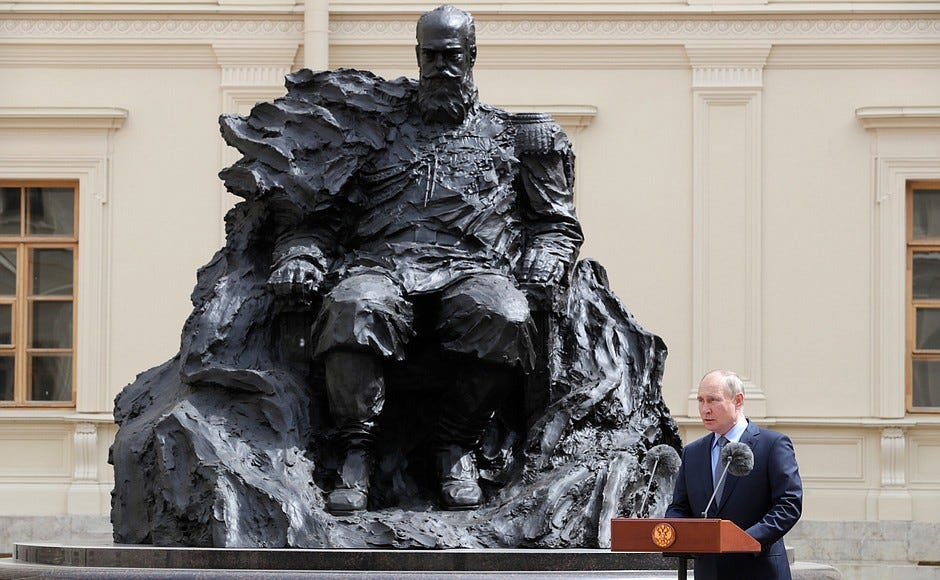
Monuments to Alexander III further illustrate this revival of tsarist imagery. Alexander III, often remembered as a staunch conservative and defender of autocracy, is celebrated in several cities with statues and memorials. On June 5, 2021, a monument to Emperor Alexander III was unveiled, celebrating the 19th-century ruler whose reign left a lasting mark on Russia’s history. At the ceremony, President Vladimir Putin praised Alexander III as a leader whose legacy “has entered Russia’s history forever and is connected with important and meaningful achievements.” He highlighted the emperor’s ambitious projects, including the construction of the Trans-Siberian Railway, as evidence of his dedication to Russia’s progress. Putin emphasized that Alexander III “loved Russia. It was his life, and he strived to do everything for its steady and confident progress, for the protection of its interests and for strengthening the Russian state in Europe and globally” (Kremlin.ru, 2021).
Putin acknowledged that historical assessments of Alexander III have been mixed but argued that his era exemplified a “natural and harmonious blending of large-scale technological, industrial and government transformations and loyalty to national traditions, culture and origins” (Kremlin.ru, 2021). He framed the monument as a tool for educating young people and promoting patriotism, noting that initiatives from historical societies and cultural organizations would support “teaching patriotic values to young people.” Concluding his remarks, he described the monument as a symbol of “the restored continuity of time and generations,” linking respect for Russia’s past with the nation’s capacity to move confidently toward the future (Kremlin.ru, 2021).


On September 14, a new monument to Emperor Nicholas II was unveiled in the village of Sanino, located in the Petushinsky District of the Vladimir Region. This installation is the first of its kind in the Vladimir region and ranks as the country’s second-largest monument dedicated to Russia’s last tsar.
The bronze statue, created by Moscow sculptor Rovshan Rzayev, was placed on the grounds of the Church of the Chernigov Icon of the Mother of God. Its unveiling coincided with the church’s patronal feast day, and the ceremony included a Divine Liturgy led by Metropolitan Ambrose of Tver and Kashin. Approximately 500 people participated in the service, procession, and consecration of the monument.
The monument stands nearly 10 feet tall including its pedestal. Nicholas II is depicted in full uniform with his coronation mantle and a sword at his side, holding an orb in his left hand while his right hand forms the sign of the cross. The pedestal bears the inscription: “Nicholas II Tsar and Passion-Bearer.”
The rehabilitation of Nicholas II completes Russia’s symbolic turn toward the tsarist past. Once vilified for his role in the collapse of the monarchy and the upheaval of 1917, Nicholas II has been gradually recast in public memory as a martyr and a figure of national tragedy. Monuments and museums dedicated to him present a sanitized narrative of his reign, emphasizing personal piety and familial devotion over political failures. This selective commemoration allows contemporary Russia to embrace the prestige of its imperial heritage while sidestepping the controversies of monarchy’s collapse, integrating Nicholas II into a broader historical narrative that reinforces current political authority.
During the Soviet era, Nicholas II had been vilified and largely erased from public memory, with no monuments dedicated to him. Over the past three decades, however, more than 100 statues, busts, and memorials honoring Nicholas II have been erected across more than 30 regions of Russia, reflecting a renewed interest in commemorating the last imperial ruler.
Russia’s approach to history is not limited to constructing monuments or celebrating selective figures; it is equally about erasing, silencing, and controlling the past. Memorials to victims of Soviet repression are systematically dismantled, and the physical spaces that once commemorated suffering are being replaced or erased entirely. At the same time, laws ostensibly designed to prevent the “rehabilitation of Nazism” or to prohibit “discrediting the army” have been weaponized to criminalize alternative narratives, targeting historians, activists, and organizations such as Memorial. These legal and cultural measures ensure that the only permissible story is one of unbroken strength, heroism, and sacrifice, framed against foreign adversaries.
By suppressing memories of repression, failure, and internal conflict, the state creates a historical landscape in which shame, moral ambiguity, or dissent have no place. The result is a tightly controlled narrative in which Russia’s past is rewritten to justify the present, presenting the nation as a continuous bastion of power and resilience. Through this process, the Kremlin not only elevates symbols of victory and martyrdom, but also implicitly teaches that national identity is inseparable from state authority and loyalty, leaving little room for critical reflection or alternative interpretations of history. In this sense, the war on competing memory is as central to the Kremlin’s project as the monuments themselves, shaping not only what Russians remember, but how they are allowed to think about their past.